
Retreat report by T.M.

Reflections from Western Zen Retreat October 11th – 16th 2019 Dharma Drum Retreat Center

“Nothing matters, and everything must go, Yet love is having the heart touched in the valleys of suffering”

These words which were part of the liturgy recited at the retreat really sum up how I am post-retreat.  I also cannot help but recite these words and I cannot remember exactly where they are from but

“When I close my eyes and look within I know I am no-thing and this is wisdom, when I open my eyes and look outside I know I am everything and this is love”

As I’ve said to yourselves and to many other people since, this retreat with its very special format should be compulsory for everyone who considers themselves “a meditator”.  I have been practising so called meditation for embarrassingly many years yet I now feel I know what it really means to meditate properly and to understand the simple truth of when I’m not meditating. The insistence on moment by moment mindfulness of everything going on in the body, mind and environment yet remaining completely relaxed was compelling.  I realise I’ve been pretty good at the body sensations and the environment but tracking my own mind/emotions on a moment by moment basis has really opened me to my denied and disowned suffering and given me the ability to really empathise with others, developing compassion with the listening exercise repeated over and over and over again.  I was so amused and guilty on the second day when Rebecca spoke of how “Buddhists” struggle with this retreat more than others because of our “Buddhist concepts” which of course, I was naively spouting after a few rounds of the “Who are you?” – “well I’m pure awareness” “I’m empty”- hee hee!  Instead of being prepared to go in to the 100,000 caves in the dark mountains (a reference back to my koan on my first Chan retreat) and shine light on that which I have not explored.

There were revelations of course, regarding my childhood, my behaviour, relationships, emotional baggage and more but all happening in the now and passing through, bringing me to a deeper understanding of the Rumi poem – The Guest House.  I noticed my constant rehearsing of conversations!  I do this all the time, I mean all the time.  Is this as a result of my fear of rejection, reprimand, confrontations? – I seem to be treading on eggshells so often around men in particular, no wonder my throat chakra and surrounding areas (shoulders) are suffering!  And then Rebecca’s reminder to be careful of “I already know” – constantly reminding us to stay curious, explore, allow and taste and check.  Tenderly caring for our suffering, tenderly care for the grief, loss, sadness etc. It was moving and painful to hear others whose suffering was great and to feel in others their inability to “open” and as such block themselves, but as Rebecca taught us, everyone does this at their own pace and in their own time.  Reminding me of the word “titrating” which we often use in our Sangha.

This all lead to a renewed appreciation and understanding and I could even say embodied experience of impermanence.  Drilling the fact of the coming and going of everything except this always present, available and unmovable silence.  What more is there to say?

Words cannot quite .………………………………………
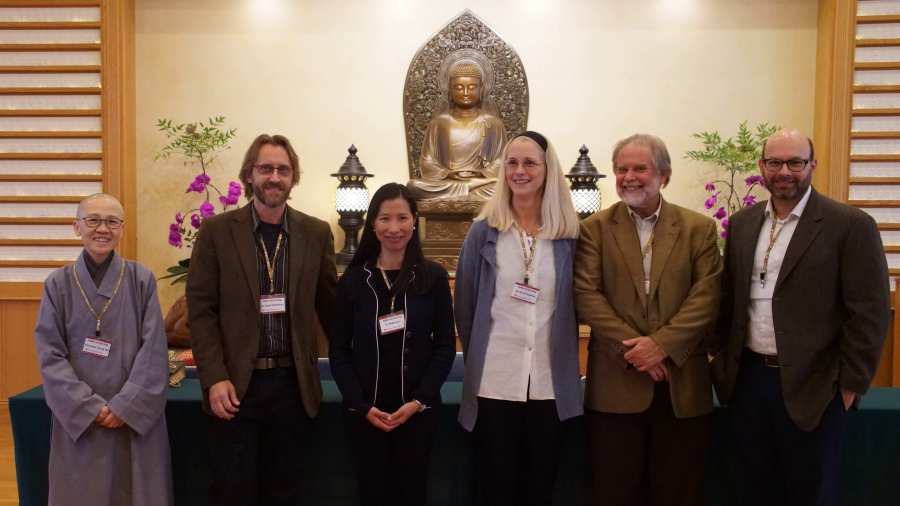
Retreat Report by P.T.

WESTERN ZEN RETREAT 2019 – A REFLECTION 

I came to the Western Zen Retreat because it offered opportunities for personal interviews.  I have been in another retreat with Rebecca, and have also had an interaction or two with Rebecca outside the retreat.  There was no way I was going to turn down a chance to have several personal interviews with her.  I knew nothing else about the retreat, and I’m glad I did not.

I struggled throughout the retreat.  I’m used to having 6 cups of coffee before I leave for the office in the morning.  And there was no coffee at the retreat!  I could barely stay awake on Saturday.

The biggest challenge for me was the communication exercise.  I found myself going back repeatedly to my “greatest hits:”  I’m the black sheep of the family; I’m a loser; I’ve been given opportunities and assistance no one else has received, and look where I am despite all that; I am yet to grow up and become an adult; Look at the others I know – my brother, my parents, my friends—see how much they have accomplished; I am an addict; All I do is move from one pleasant sensation to another.  I talk the talk but don’t walk the walk.

And then came my personal interview with Rebecca on Sunday.

I can’t remember what exactly Rebecca said, but the rug was pulled out from under my feet.  All these responses I had disclosed to various partners were narratives, nothing more.  All they did was confine me in set patterns of responses and behaviors.  They imprisoned me.  A heavy, unbearable burden had been lifted.  The elation that accompanied the sense of freedom was palpable.

But this was only the beginning.  The exercises did not get any easier.  If I wasn’t all those things I believed myself to be, then who was I?  I struggled more.  I tried at all times to be genuine and state what was arising at the moment, without being influenced by responses I heard from my partner, without any intention to impress my partner or gain sympathy.  I attempted to stay with the top plate.  I was searching, honestly.

What I want to add is that the process of unraveling continued after I returned from the retreat.  It is still working in the deep recesses of my mind, even (annoyingly) when I am asleep.  The energy from that well keeps on flowing.  It is 10 days now since the end of the retreat and the unraveling has not ceased.  Something foundational continues to stir within me.

As a manifestation of that change I have not resumed coffee—I realized I was drinking coffee just to do something, to be distracted; how could anyone like dark, black, strong coffee!  I have not had alcohol or cannabis.  I indulged in these until the very day I came into the retreat.  There are many other behaviors I have had difficulty with in the past that seem to be falling away.

There are many new behaviors that are beginning to take their place.  Wholesome behaviors.  I am being less defensive, more open, more expressive of affection toward my children, my mother, and my friends.  I spend more time with my 87-year-old mother.  I am more open to self-evaluation at work.  I’m looking less toward others to satisfy my need for connection.  I am becoming more respectful toward myself.  I am more comfortable being by myself (it’s Saturday evening now and it would have been inconceivable that I am not out partying!).

I will close my reflection with something I came across the day after I returned from the retreat.  Talk of serendipity!  “Through the constant refining of the self—of teasing out what is not self and letting it go—we suffer less, get unburdened, feel lighter.  We become more adept at discerning when something is within our control, and bears our acting on it, and when it doesn’t.  We can see what kind of perception of self is skillful and put that into practice for as long as we need it, thereby cultivating a reliable inner strength that can ferry us to the other shore.  To be one’s own mainstay is to be one’s own self help.  Teaching us to do that is the Buddha’s ultimate gift.”   From Tricycle’s Daily Dharma, “Saving Vacchagotta,” by Mary Talbot, October 17, 2019.

And that was the greatest gift I received from coming to the Western Zen retreat.  My deepest bows of gratitude to Rebecca, Fiona and Hillary.  May you be blessed abundantly.

Chan Practitioners as Agents of Social Change

Rebecca was invited to present her work at the conference “Buddhism and Social Change” hosted by the University of British Columbia and Dharma Drum Vancouver Center on September 21, 2019.  The title of her paper was “Chan Practitioners as Agents of Social Change” where she explained the importance of cultivating sociological insights in invisible dynamics in social life for Chan practitioners to effect social change that is in accordance with wisdom and compassion. 

DSC0593201(Source: Dharma Drum Vancouver Center.  From left to right: Ven. Chang Wu; David McMahan; Rebecca Li; Wendi Adamek; David Loy; Jonathan Gold)

Practicing Patience-Endurance in a Politically-Divided World

In this polarized political climate, many people are suffering from strained relationships as their friends and family members hold very different political views.  Rebecca spoke on how Chan practitioners can use this as opportunity to practice to cultivate wisdom and compassion as these relationships continue.  This talk was given on September 15, 2019 at the New Jersey chapter of DDMBA in Edison, NJ. 

Retreat Report–Anonymous

Three years ago, I joined my first SI retreat.  The experience of the first retreat is like to be locked in a solitary confinement.  I was struggling in enduring both physical pain and emotional stress.  But I did get a breakthrough of a complex that had been bothering me for years.   This time, I’m more adapting to the scale of sitting sessions.  There is less resistance from the body or the mind.  But there’s also an added layer of expectation and fear.  Am I going to have an emotional meltdown?  Am I able to face the truth of my imbalance? Even after the registration, I’m still hesitating whether I have the courage to face my own shame and insecurity.

Surprisingly, on the first full-day of the retreat, I have a serene experience of sitting after Simon’s guided relaxation.   It is simply peaceful.  My heart is filled with joy and I feel in harmony with the body and the surrounding during the sitting. I was expecting a teary journey for the nine-day retreat.  And I have a complete opposite experience on the first day.  Really?  Can the mind really be at ease and peace?  Can it be so simple to get rid of the perpetuating suffering in life?  I’m so grateful I have a taste of peace and joy from Silent Illumination. In the interview, Simon points out that there is no involvement from the mind.

For the next two days, I want to have the “happy” experience again. It seems like the correct outcome matching with the description from Shifu’s book of Silent Illumination. But, of course, with the wanting, I’m falling into the secondary.  In the interview, Rebecca reminds me that there is no judging the good experience vs the bad.  Coming back from the interview, I stop trying to cut off the “irrelevant” thoughts any more.  The mind is not focused; thoughts about work, family, conversations, and memories just come up randomly. I’m just in this messy state one sitting session after another for few days.

On the 6th night, the meditation session is extended from 40 minutes to 1 hour.  After settling down on the cushion, I catch myself getting worried that I can’t make it through the whole session.  It’s shocking to know that I’m so deeply concerned about being labeled as a failure even just for a sitting session. I can almost hear my mother’s disapproving remarks if she knows about this. I’ve been conditioned to prove myself over and over again in the race of accomplishments. I have to come out on top in getting good grades, going to good schools, grabbing promotions at work, and making my children getting good grades, good schools, good jobs also. I put unnecessary pressure on myself and my children. I always feel that I’m not good enough and I make my children feel the same way.  The one-hour sitting goes by smoothly as the mind is engaged in the investigation and getting deeper insight.

During the interview on the 7th day, Simon mentions 3 steps in facing my fear.  First is to recognize I was trapped in this mode of fearing my mother’s judgment. Second is to be aware of my emotions when I face the judgment. Third is to communicate with her about my true feelings. The mind is focused on the investigation for the rest of the retreat.

In the afternoon of the 8th day, we have a meditation session in free format for the entire afternoon.  I choose to sit by the window feeling both relaxed and motivated. In the investigation, I keep on repeating a comment “you are just so-so in your life” to see how I take it. I try to think of something positive of myself to refute the criticism but I find it extremely uncomfortable in doing so. I’m just a mediocre, I’m just a faker. Nothing is worthy of recognition. It is I who label me as a failure. I accept that I am a disappointment and I think I deserve the shame. I put the curse on myself. It is an overwhelming realization and tears start coming down.  I find the root that causes me so much pain; and it is all generated by my own mind.

In one of the Dharma talks, Simon mentions that we often practice the First Great Vow as to deliver innumerable minus one sentient beings. We tend to put our own self as the last one to pay attention to. I realize that, if I don’t build myself up, I’ll continue to inflict the same harms I felt to people around me.  I’m a victim and a persecutor as the same time.  The vicious cycle will continue to the next generation; and the harm can spread to innumerous sentient beings. I have to work on it, accepting myself and catching myself falling into the trap of shame.

I have strong faith in using the method of Silent Illumination now.  It has helped me resolve some perplexing issues at both retreats. I also have better understanding of how to use the method, dropping the controls and simply being aware of the presence. It is a valuable journey to get to know myself and to strengthen myself. I’m grateful for our teachers, Simon and Rebecca, in clearly explaining the subtleties of “the method of no method”, and in guiding us applying the method for our life investigation.

Buddhadharma: Ask the Teachers—Rebecca Li (August 2017)

How can one “take on the suffering of the world” or practice “for the sake of all beings” without also inflating their own sense of self-importance?  As profound as these practices are, they also seem like fodder for the ego. 

As an antidote to the sense of arrogance that may arise when we think “I am doing something so selfless, aren’t I great?”, we can practice giving rise to gratitude for the opportunity to serve.  In particular, we are grateful for all the causes and conditions that make it possible for us to practice and to help other beings through our practice.  Some of these causes and conditions include the fact that our health, family and financial situations are not so desperate that we cannot think of anyone else, the opportunity to study with good teachers who inspire us to practice for the sake of all beings, and the direct and indirect supports we get from so many other people who make our own study and practice possible.  In this way, we realize that we can practice for the sake of all beings not because we are inherently better than others, but rather because numerous causes and conditions have come together to make it possible for us to practice this way.  Part of our practice is remembering to be grateful for this and to understand that practicing for all beings is merely a way to repay everyone who supports and loves us in their own ways.

We can also remind ourselves that while we attempt to help others to alleviate their suffering, whether or not we are successful, in that moment we alleviate our own suffering as we cease to obsess over our own difficulties.  Instead of thinking that we are such great people to be helping others or taking on their suffering, we should thank all beings for allowing us to attempt to play this role.  Just because we want to help does not mean that others have to allow us to help them. The fact that our friends, loved ones and strangers allow us to be there for them, retreatants show up for retreats and practice under our guidance, and practitioners attend our talks or seek our advice should be appreciated as their generosity to let us into their lives and their wisdom to recognize the value of the Dharma.  Without other beings who are willing to open their hearts to receive what we can offer, we would not have the opportunity to deepen our understanding of the Dharma by offering ourselves.  With this attitude, we are less likely to give rise to a sense of ego-feeding self-importance.

It is gratifying to see people’s sufferings lessened in part because of our effort.  We may experience good feelings that can be encouraging and inspiring and these are useful for sustaining our practice on the Path.  If we maintain a clear awareness of what arises in our mind moment after moment, with patience and diligence, we are likely to catch the moments when these good feelings start to turn into a sense of self-importance.  In these moments, if we practice remembering to be grateful for the opportunity to serve and for all the causes and conditions that make it possible for us to practice in this capacity, the sense of self-importance will dissolve on its own.  But, we are only human, so patience/endurance is important, as it can be enticing to let those pleasant sensations associated with thoughts like “I am so selfless” to grow into a full-blown belief of self-importance.  We need forbearance to let go of this self-aggrandizing chain of thoughts.  Diligence is also important.  Just because thoughts of self-importance did not arise in the last moment, it does not mean that we no longer need to be vigilant this moment, or the next.

Retreat Report by I.U.

Silent Illumination Retreat report, 5-25-2019 to 6-2-2019 at DDRC

I was in a bit of a funk when I arrived for this retreat. I had been practicing too hard in my daily life and had a bit of an eruption. Had to take a few steps back. As a result, I was the least excited about this retreat that I had ever been. I was just there to practice and see what happened I told myself.

The instructions given were similar but different to other retreats, even other Silent Illumination retreats. Yes, it was still brightly illuminate the mind, be aware of the body, environment, all of mind, but unlike the other retreats I had attended there was a component to explore thought. In every other retreat I felt that if I started to have thoughts I was somehow failing. If I caught myself thinking, the thought had to be brushed away. Even the tiniest little bubble of thought was a failure. Here, though I was encouraged to allow the thoughts to wander through the mind. So long as I did not forget where I was, losing the present moment, the thoughts were to be allowed to remain.

After a couple of days, the mind started to settle down a bit, but it was still thinking all the time. In the lectures, Simon told us to completely illuminate the thoughts. I was having all these thoughts about planning for the future, rehashing old arguments from the past. The vast majority of my mental commentary fit into these two categories. When I started to completely illuminate them, I had to start investigating where they came from, and I discovered much to my dismay that they came from pride, from thinking that I was more special than anybody else.

This was a bitter pill for me to swallow, but that’s what I came to the retreat for, so I just kept on practicing. Whenever a thought arose, I began jumping straight to the root. “Another thought based in pride, let it go.” “Planning for the future again? Let it go.” Mind began to gel, so that everything was flowing together. Yes, there were thoughts, yes there was wandering mind, but it was like the great ocean heaving quite naturally, nothing to fear. I was at peace with what was going on, until I started trying to sit double sessions and ran into the pain barrier.

I had an interview with Rebecca where we talked about this. She had me describe the entire process of my experience leading up to my breaking posture. How the pain would grow, how I would just try my best to hold on, widen the focus, let the pain be just a little part of the overall experience. How it would grow and grow until I had a little conversation with myself, convinced myself that it would be better to just give up, that there would just be more sitting, more pain to sit through afterwards. She asked me if there was any real life situation that mirrored this experience, and I described my most recent bout of home training difficulty. I talked about how I had a habit of walking away from things that were difficult, from situations or people that didn’t bring me the fulfillment that I wanted.

I had been living for some ideal future, practicing for some idea of fulfillment that actually had no basis in reality. It was all just a dream. I could see quite clearly how the meditative experience of Chan is a microcosmic reflection of every day life. The same problems and patterns that are present in mind out in the world will arise on retreat. I was told that the real work was to be done in my normal life, that if my meditation as ever to progress, I would need to deal with this pattern of disengagement in my own life. I generated the intention to live an ordinary life, and it was the hardest thing I have ever done. I generated the vow to put down all dreams and just live in the present moment.

After that interview, I went back to the entry hall and just wept. I cried grieving all of the dreams I was giving up, all of those dreams I had held close to my chest for so many years. Behind all of this pain, I glimpsed something extraordinary. What happens when dreaming is over? There is an awakening. I spent the rest of the retreat trying not to run away from this resolution. There was such a tremendous sense of, “Oh wait! No! Not yet! I could be more!” I did my very best, but I’m not there, not yet anyways.

Coming home was not what I expected it to be. I’d had all these thoughts of the big changes I was going to make in my quest to live an “ordinary life,” but have realized that those thoughts were kind of absurd. They were just another attempt of the ego to be special, just special in being the “most ordinary!” What is ordinary? I think that it’s just what is natural. What is it to live awake? To be aware of what is coming and going in mind. Putting these two together, what is an ordinary but awake life? To be free and natural to be what you are and not be confused about what is going on. This will be my operating basis for this next leg of practice.


Retreat Report–T.F.

Hi Rebecca,

I attended your retreat this weekend at the suggestion of my doctor.  He is a wise and compassionate person who I have come to respect and rely upon to help me acknowledge, understand and live with PTSD. So when he suggested your retreat I signed up without question and I cannot say I that expected anything in particular but I will say that by Friday night and into Saturday, I thought he had lost his own mind for thinking I could do this retreat.  I was tempted more than once to get in the car and drive home.  I encountered many difficult personal challenges throughout the weekend and feel that the 2 days I spent on your retreat were more difficult than the 8 weeks of Basic Training I did in the Army.  Upon reflection, I am pleased that I completed the retreat as it was a positive and powerful experience of self awareness for me.

There has never been time when my mind was not troubled. My doctor introduced me to meditation and it helped me to focus on my breath which in turn slowed down my thoughts and reduced the noise but I did struggle with pushing away the thoughts and feelings that came up as fast as I could and didn’t understand how to apply meditation to everyday living.  Your guidance throughout the practice this weekend allowed me to finally understand what he has been telling me.  Your words this weekend echoed his and it just all clicked together at the right time,in the right place  and with all the right people. You asked us to let you know what we wanted to take home from this retreat and my answer is clarity of mind and the ability to be present in my own life.

Yesterday, my first day back from retreat, I got stuck in traffic on my way to an appointment. It is a fact that I do have road rage and I immediately became angry and frustrated and then I heard “this is a good opportunity to practice”.  It made me stop, it made me think of you and my doctor and I smiled as a great sense of accomplishment grew within me and I sat in traffic, still annoyed and anxious but when I got to my doctor’s office I was able to laugh about the traffic and I had a good day.

I am grateful to you for allowing me to practice under your guidance and for your patience throughout the retreat.